
Jasper Schut
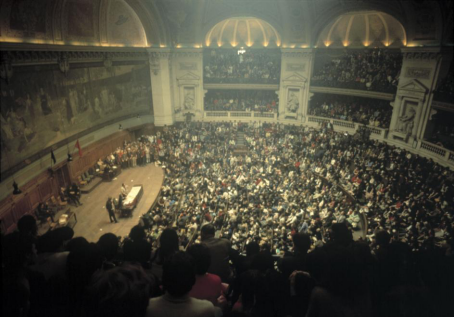
The university is in ruins and still we should work towards its abolition (Readers, 1997; Harney & Moten, 2013). These two things are nothing but mutually exclusive. The university being in ruins comes from the idea that the role of this institution is no longer clear within the modern capitalist society. It used to serve the nation state and the reinforcement of its national culture, applicably called the university of culture (Readers, 1997). This is more and more being replaced by what Readers (1997) calls the university of excellence. A place that serves international capital, functions as a corporation and has the generation of profit instead of knowledge as its goal. It was a shift that went hand in hand with the rise of the neoliberal economic order. This shift is also described by Saunders (2023) as a shift in the raison d’être of the university from that of a public good to a private investment for an individual. Up until the 1970’s university was also viewed as a means to creating a more educated population and labour force. What came after was, just like any other neoliberalisation, an attempt to further commodify and exploit what is situated in and comes out of academia. All the while, the university still holds up a veneer of being an institution of enlightenment, progress and one that works for the commons good –“positive societal impact, the erasmian way” my derrière.
Academia clings on to the outdated role of the university being a public institution that defends culture on behalf of the nation state. Readers (1997) describes the modern university as an institution that is in ruins as it has lost its historical raison d’être of defending the nation state. Two decennia later, I would argue that the raison d’être has been firmly established, even getting solidified after the new austerity measures planned by the new far right government of the Netherlands. The exploitation of student and academic labour has been accelerated massively (Saunders, 2023). This serves capital in two ways: it produces more labour-power in students while working in the university industry and also by cheapening the exploitation of the knowledge being produced. The university of excellence is there to serve itself as a corporation.
There is one group of people that occupies space in these ruins that doesn’t seem to fit within this raison d’être. The people that want to undermine the system, the critical academics, the professionals, the activists, the annoying class reductionist Marxist philosophers, the people doing (and teaching) engaging public issues. Here I also find my connection with the issue of the university. As a student activist and organiser, I want to struggle against the system in my own community. I will come back later to possible relations to the university but for me, the idea of in-against-beyond and the criminal relation are essential (Saunders, 2023; Harney & Moten, 2013). I’m in the university while being against it and struggling for something beyond it. The goal of this paper is then to explore how to best do this. This means an inquiry into the theories of change that drive social change such as those put forward by Jane McAlevey (2019) and how they relate historically and tactically to the context of the university. In other words, how do we organise in the university. Here I’m mainly interested in the specific public of the student and that of the critical academic. The former being the group I’m personally trying to organise and the latter playing an interesting role in this.
To understand the modern university better, it is useful to have some understanding of how it came into being and how different publics related to the university. The emphasis here will be on the role of the university and how people organised and agitated. I will use two distinct but complimentary frameworks to analyse this historical period, a Marxist one derived from the work of Gary Saunders (2023) and a more cultural approached from the university in ruins (1997) by Bill Readings. Saunders (2023) writes specifically about the English context and the policies there. Starting in the post world-war two period, an idea of the university being a public good dominates. There is the general idea that a more educated and skilled workforce is necessary to be a competitive nation. To do this, there is more state involvement in the expansion of higher education. This leads to a mass higher education system, a publicly funded system with the ambition to create as many skilled workers as possible. The driving force is making Britain a more competitive nation trough the enhancement of labour-power (Saunders, 2023).
The role the university plays in the nation state and its identity is emphasized by Readings (1997). This university of culture he writes about, exists in the same period as the public university and is one and the same I would argue. Although Saunders (2023) has a slight focus on the technical education and Readings (1997) the cultural and social side of academia. Both ultimately serve the reinforcement of the nation state and capital accumulation that takes place within it. Readings (1997, p. 69) describes the role of the university of culture as such:
The University’s social mission is not to be understood in terms of either thought or action. The university is not just a site for contemplation that is then to be transformed into actions. The University, that is, is not simply an instrument of state policy; rather, the University must embody thought as action, as striving for an ideal. This is its bond with the state, for state and University are two sides of a single coin. The University seeks to embody thought as actions toward an ideal; the state must seek to realize action as thought, the idea the nation. The state protects the action of the University; the University safeguards the thought of the state. And each strives to realize the idea of national culture.
The role of the university is thus twofold. It is a common good that provides society with more skilled workers to make a nation as a whole more competitive in the global market. On the other hand, it legitimises and reinforces the ideas that are associated with the nation state.
Then what happens when the nation state declines? What happens when the very thing that gives the university its raison d’être is in decline? This is the process happening from the 1970’s onward but it really accelerates in the 1990s (Readings, 1997). This is the process of neoliberalisation and globalisation of the economy. A process of privatization of public institutions, offshoring of industries and the erasure of any obstacle for global capital. These things undermine the national ideology of a nation state which in turn erodes the role of the university, leaving it in ruins (Readings, 1997). The university itself also has to adhere to the new logic of privatization, meaning a power shift from academics and different departments to centralised management (Saunders, 2023). Universities become more dependent on private financing, have to increase efficiency (read fire or underpay workers), start contributing to economic growth and open up to businesses. All this turns the university in to just another corporation. This new economic order gives rise to the idea of excellence, even though it is a fundamentally empty notion (Readings, 1997). It is a way to communicate an arbitrary standard that can be moulded to the circumstance at hand serving the interests of that time. This makes the university a completely self-centred and bureaucratic institution.
Besides the changed role of the university within society, the internal organisation and production also changes drastically. The neoliberal university further perpetuates capitalist relations in academia and commodifies what is being produced (Saunders, 1997). For the next part to make sense, I will shamelessly use Marxist logic of value and production, however faulty it may be. According to Saunders (2023), the main work conducted in a university is that of teaching and research which is often carried out by the same people. While academic labour is just another service that can be exchanged, the use value produced is more abstract. This is the added value to the student’s labour power to be more employable later. Here, students are not mere consumers but unpaid co-producers. They have to discuss, write, review, read et cetera. The research being produced is value that can be appropriated by individuals or organisations outside of the university (Saunders, 2023). The neoliberal university tries to produce more labour-power in students as cheaply as possible and makes the production of knowledge cheaper. This increases the precarity of labour in the university for staff and for students. Maybe the most important conclusion that comes out of this history and role of the university, is that academia is just another industry. A very specific industry that plays a very particular role in the capitalist system, especially in post-industrial countries, but an industry, nonetheless. It operates on largely the same class divide of work and capital where students and staff are workers, the administrations interest almost always aligns with that of capital. The university works on the same exploitation of unpaid labour that largely follows gender and racial lines and also undervalues all the reproductive labour that keeps the university running. What this seemingly negative shift in attitude does is allow us to think differently about how we relate to the university. It no longer requires us to be loyal to the institution because we are doing something for the greater good. When we see the university an industry, it allows for industrial action, it allows us to organise. In, against and beyond.
What it also does, is uncover the different publics involved with the university. I will start with the publics that represent the side of capital. This is usually the administration of a university. These are usually appointed boards and layers of management that run the university like a corporation (Saunders, 2023). Their goal is usually (economic) growth and an increase in efficiency. A next public are companies, they work closely with universities. They have influence on curricula, provide funding and recruit at the university. Their interest is that of skilled labour and the privatization of the knowledge produced at a university. At last, there is the government, it is the main funder of Dutch universities and has massive influence on how they operate. With the decline of the nation state, its interest is largely the same as that of transnational cooperations. It facilitates the production of knowledge and a skilled workforce. This increasingly means getting less involved with the university by means of austerity measures and privatisation. What is interesting here is that there is a conflicting interest here, especially in times of rising nationalist or even fascist sentiment. These currents heavily rely on the nation state for their legitimacy and for that they need the university. In the Dutch context this doesn’t mean a shift towards the public university as that would require more funding and government involvement. Instead, there is more so a push for policies that establish national identity such as limiting international students and a reintroduction of the Dutch language in academia. This, in a way, restricts the flow of international capital going against its interest.
On the side of labour there is firstly the staff. For this paper I will focus on academic staff. However, the almost always overseen non-academic staff is equally important. Like any system, the whole thing would collapse without them. I’m very aware that what I’m doing in this paper is again, the reaffirming of the critical negligence of what goes on in and comes out of the undercommons (Harney & Moten, 2013). I’m participating in the professionalisation. This also means that in this paper, this group and this foundation isn’t heard. I would argue that the only implication is that we should think of how to build solidarity. Academic staff is a highly divided public with varying degrees of precarity. It’s a complicated hierarchy that ranges from professor to PhD candidate and tutors. For the academic staff there often is a conflicting attitude towards their role in the university. The first aligns with the public university or the university of culture, they are there for the betterment of society, to teach people to become more critical members of society (Readings, 1997; Saunders, 2023). Maybe they even try to implement elements of critical pedagogy to achieve this. Their research is meant to promote progress for the nation state or humanity as a whole. This attitude is usually abused by the institution. It draws people in under false pretences of progress and enlightenment to then use what they call love or passion but what is unpaid labour (Harney & Moten, 2013). The second attitude is one that aligns with the university of excellence and the neoliberal university. Their teaching is more transactional where they offer a service for students to consume. Teaching and research might be done for capital gain or just simply as a job to make a living.
The next public is that of the student. This is by far the biggest public in the university. For this public there is also a conflicting attitude similar to that of staff. That of studying to become a more productive or good member of society or to be the consumer of a service for the furtherment of a personal career. There is a third, universal, interest for this public and that is gaining access to the (problematic) public sphere (Readings, 1997). To make the transition from ignorant to knowledgeable. From student that isn’t to be taken serious to adult, someone that is allowed to have an opinion on things. This of course already relies on the idea that the public sphere is dominated by academia, undermining its very ideal. It was also the Parisian student revolt of 1968 that agitated against this phenomenon (Readings, 1997; Saunders, 2023). What students are in the end is also just workers, regardless of their own attitude towards university (Saunders, 2023). They participate in the knowledge production of the university and their education is part of the necessary step to becoming a good worker. This gives them a lot more agency for action against the university than being passive consumers.
There is one public that cuts across the publics of the student and the staff which is the critical academic. These are people who seek refuge in the university as they use the little hospitality that’s there (Harney & Moten, 2013). They try to live in the cracks of the system while being against it. Even though the university thrives on their ‘critical’ work as this is labour it can use to further professionalise. Critical academics are often very comfortable in the university as they are allowed to be critical, it makes them controllable, maybe even docile.
Now that we have an idea of what publics are involved with the university, I would like to take a slight detour before we move to what role they (can) play in undermining it, how they have done so in the past and how we can move forward. I want to cover how people can effectively organise and agitate against the system. This can be used to as a framework to analyse history, the different roles of the publics involved, and it can give us ideas of how we can implement these tactics in the specific context of the university.
The framework I’m using the one put forward by legendary organiser Jane McAlevey. In her book No Shortcuts; organizing for power in the new gilded age (2018) she lays out a critique of current day social movements and what must be done. This critique is threefold: first, progressives and leftists have over the past decades moved away from deep organising towards a shallow mobilising (McAlevey, 2018). Second, there has been a split between social movements and the labour movement. Third, different ways of trying to work towards change get different outcomes, a different victory. Only one of these strategies can effectively confront power effectively. These three types of change are: advocacy, mobilising and organising. The first approach, advocacy, doesn’t rely on masses. It is a method that uses backroom deals, lobbying done by elites, experts, lawyers and interest groups. They focus on very small wins and policy changes. Although perfectly fine for getting companies to use paper instead of plastic straws, it doesn’t challenge power structures.
The second approach is mobilising. This approach does focus on large numbers of people to demand something. They are often run by professional staff doing campaigns. The numbers mostly come from dedicated activists that show up time and time again but without the support of their coworkers or fellow students. Usually with the sole effect of getting a nice picture for social media and an article in a few news outlets (McAlevey, 2018). Often the professionals engage in secret backroom deals without the involvement of any of the non processionals involved with the campaigns.
The third approach is organising. This approach completely focuses on a constantly expanding mass of people that were usually not previously engaged. All agency for success is with this mass of people. Their motivation is a specific injustice or outrage but the goal is a transfer of power from the few at the top, to the many at the bottom. Instead of backroom deals and professional leadership, this method includes everyone that’s organised. This is in the strategy, the negations and all other factors of pushing for change, all agency is with them (McAlevey, 2018). Once a sufficient mass is organised, change is achieved through the withdrawal of labour or direct action. The goal is to create a crisis big enough that it is impossible to not give in. This makes the movement much less dependent on outside forces such as the media or friendly politicians. This tactic has historically been by far the most impactful. Things such as the eight-hour workday, weekends, the abolition of child labour but also the victories of the civil rights movement largely came out of this strategy.
A question remains though: how do you know when you can create a big crisis that’s big enough? The answer lies in the way the organising approach works as it is built on a method called structure-based organising (McAlevey, 2018). Organising takes place in a place where people are already located like their workplace, church, university or flat. They already have a network there. The goal is to use this network of people to organise a majority, or preferably a supermajority, of people within this structure. This way it is possible to quantify how close you are to taking collective action. This differs drastically from the mobilizing approach. Here, groups are self-selecting. People get involved because they have preexisting motivations. It almost entirely consists of people that are already agree with each other, usually activists.
To get to a majority, various tactics can be deployed to ease this process. Probably the most important one is organic leader identification (McAlevey, 2018). This is a process where an organiser tries to identify people that already have an organic following within their structure and persuade them to organise themselves and their colleagues. Another important tactic is the structured organising conversation, a 1-on-1 conversation with the goal of persuading someone to get organised. A conversation where the organiser uses the right semantics does a lot of listening to then ask the right question. This also means learning how to talk to people that might not already agree with you. The next tactic to get to that majority is the methodically charting of how well organised you are. This means keeping track of everyone in a structure and how social networks work to reach everyone. Here you also keep track of how well organised a structure is and how engaged people are. The last tactic is the structure test. These are tests to see how well organised you are, think of petitions, photos or other actions. They build solidarity and energise the movement while keeping pressure on those in power. Structure tests are endless and must be trained like a muscle to get stronger.
McAlevey (2018) describes how there is a difference in what type of structure you are organising in. She gives two examples of extremely high stakes but successful organising efforts: union organising in the workplace from the US labour movement in the 1930s and faith based organising done by the civil rights movement in the 1960s. Faith-based, and broad-based, organisations are named organisations of organisations, or O of Os. These are often religious institutions. The big difference between these and workplace structures is that they are not antagonistic towards the organiser. Their leaders, maybe a priest, rabbi, imam, board or president often welcome the organiser. Whereas in workplaces, the boss and management will fight organising efforts with tooth and nail.
This is also why most current day unions have abandoned this strategy, actively choosing for a mobilising or even an advocacy approach in their theory of change (McAlevey, 2018). In the US this coincided with the McCarthy era which did two things with the labour movement; it made them adapt these new tactics which were much easier for power to contain. Unions became external organisations that provided a service to workers and advocated for them, instead of being organisations of workers coming together to change their own circumstances. The second thing it did, is drive out most skilled organisers, their tactics being no longer welcome. This had a domino effect across social movements whereas a lot of leftists, stubborn as they are, no longer learned the art of organising and instead turned to mobilising and advocacy.
Now that I have established a framework to analyse social change, it can be applied to the university. Starting with the university as an institution; this is, as previously established, just another industry and with that, also a structure to organise. For different publics, the structure appears differently though. For staff, the structure is best characterised as a normal workplace, especially in the neoliberal university. In the Dutch context, there is still some remanence of the public university, probably making it less hostile towards organising efforts. There is a normal employer – employee (work – capital) relationship with management trying to increase efficiency and cut costs (Saunders, 2023). Although it also has a peculiar hierarchy with more and less precarious workers. I would argue that a lot of them are part of the professional managerial class, or as Harney & Moten (2013) put it more aptly, turns the insurgents into state agents. Most are workers nonetheless, often more easily exploited if their attitude aligns with that of the public university. The neoliberal university doesn’t treat them that way and sees their academic labour as a service they can buy (Saunders, 2023). Which also means that it can be withdrawn during collective action, becoming insurgent once more.
For students, their experience with the structure of the university is different. Besides the peers in their year, they are active at many different student related organisations. Such as: study associations, student associations, cultural associations, student sport clubs, student housing and all sorts of other committees, clubs and organisations. These organisations are usually run by students for students making them much less antagonistic to organising efforts, they might even be welcoming depending on the organisation. Especially with boards often consisting of engaged students already acting as leaders. The university is for students more so an organisation of organisations, a broad-based organisation (maybe faith-based in the case of the fraternities, with some combination of capitalism and alcohol being the faith). These organisations are all places within the public of students that can be organised. These are all places that are typically not a strategic target to transfer power from. As we have previously established in the different roles of the publics in the university, students are also workers and thus, also have the agency to withdraw their labour. It also means that they have a conflict of interest with capital. This is usually being represented by the university administration, the government or the municipality. Making them into strategic targets for collective action and the transfer of power. The student public is also peculiar in the sense that it has massive turnover. They are usually only in their structure for a maximum of four years, making organising very difficult. There is limited time to get to know a social structure and organise it for effective collective action, especially considering that people don’t have any social structures in the beginning. This makes for only a small window of opportunity to organise. This requires a skilful organiser to do adequate leadership identification and effectively use the O of Os to organise students.
The two publics are both agents of change on the side of labour, if they get organised. But what is the role of the third public that cuts across the two, the critical intellectual. Harney and Moten (2013, p.26) write that: “the only relationship to the university today, is a criminal one”. A relationship where one abuses the hospitality of the university, steals from it, seeks refuge but doesn’t become part of it. I agree with this to a large extent, but I don’t think it goes far enough. They themselves already point out that the negligence of the critical academic asserts bourgeois individualism and turns, trough own their labour of critiquing, the most critical academics from insurgents into state agents. Only dwelling in the university ruins to abuse its hospitality won’t get its abolition much closer as it is often done individually. So, yes, steal from the university, abuse its hospitality. But also, be an organiser. Think strategically about what you want to accomplish. Is it worth trying to shape the university trough it’s countless committees, councils and articles. Is it worth only organising little action groups to occupy buildings or do teach-ins, even though it’s a lot of fun. When leftists forgot how to organise, this also includes the leftist academics and I think it is time we remember what we did in 1968. The critical academic can function as a bridge between staff and student as their interests align. They already have access to most structures and are imbedded in the social networks. When playing the role of organiser, the critical academic can be in, against and beyond the university.
The university as an industry plays an essential role in capitalist reproduction (Saunders, 2023). For the neoliberal university is vital for the reproduction of cheap labourers and knowledge. In some cases, universities still legitimise the nation state and with that the violence that they are built on. Israel being the clearest example, legitimising the apartheid and the genocide on Palestinians (Wind, 2024). But like any other industry, it is possible to fight back against it. It is possible to bring the whole thing to a halt and not only beg, ask, steal, or dwell but to take the whole thing, as its already ours. To build alternatives with the materials of the ruins, throwing away what we don’t like and keeping the things we like. To work toward the abolition of the university is to struggle at the point of knowledge production, is to be a real criminal, is to get organised and be an organiser. In, against and beyond.
Literature
Harney, S., & Moten, F. (2013). The Undercommons: Fugitive Planning & Black Study. http://ci.nii.ac.jp/ncid/BB13042092
McAlevey, J. F. (2018). No shortcuts: Organizing for Power in the New Gilded Age. Oxford University Press, USA.
Readings, B. (1996). The university in ruins. http://ci.nii.ac.jp/ncid/BA27691697 Saunders, G. (2023). Prefiguring the idea of the university for a Post-Capitalist society. In Springer eBooks. https://doi.org/10.1007/978-3-031-46649-6 Wind, M. (2024). Towers of ivory and steel: How Israeli Universities Deny Palestinian Freedom. Verso Books

